A SHORT BOOK ABOUT SELF-DISCIPLINE

Your Discipline Isn't Broken
How to begin without wanting to
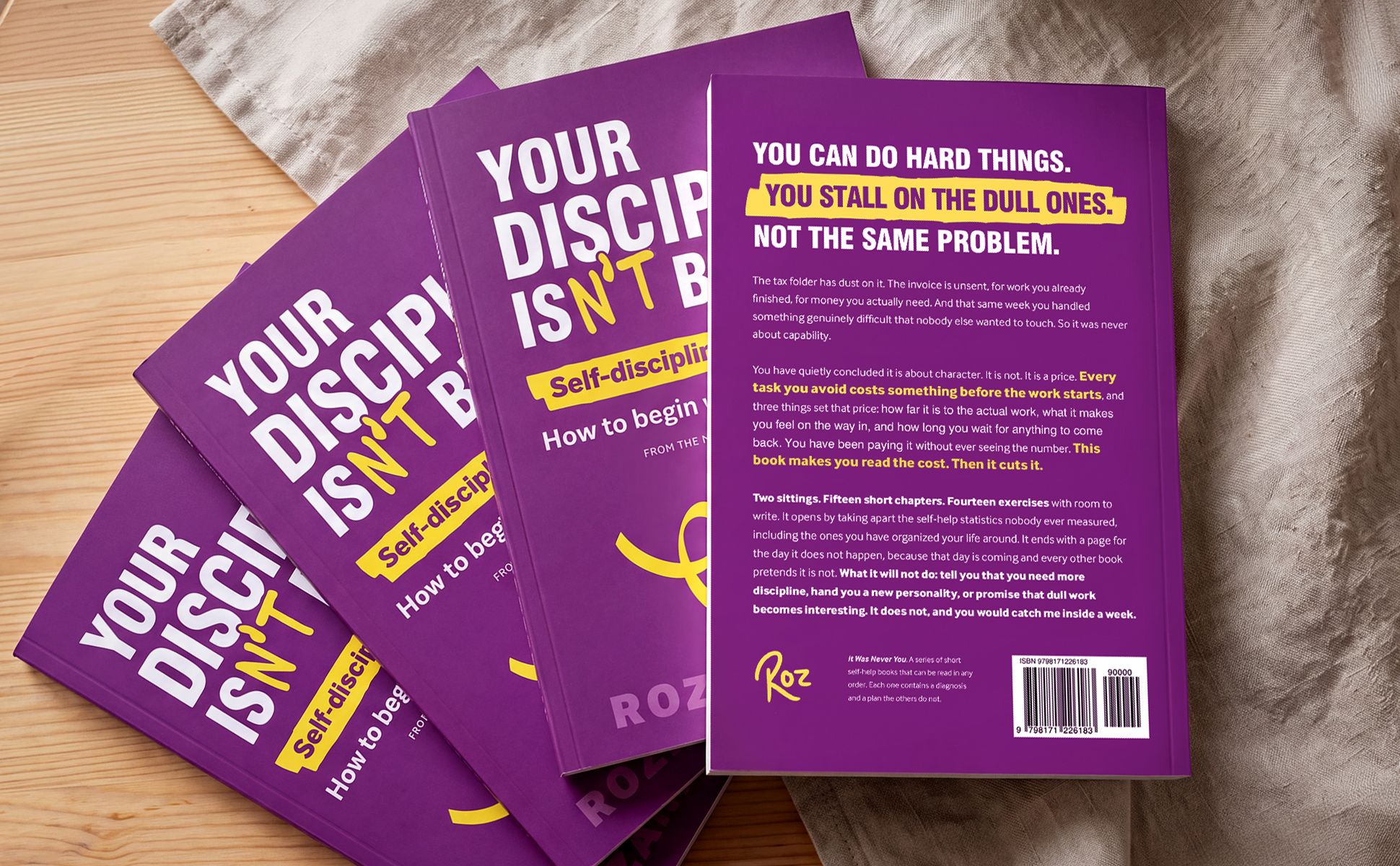
You can do hard things. You stall on the dull ones. Not the same problem.
Paperback and Kindle. From the It Was Never You series.

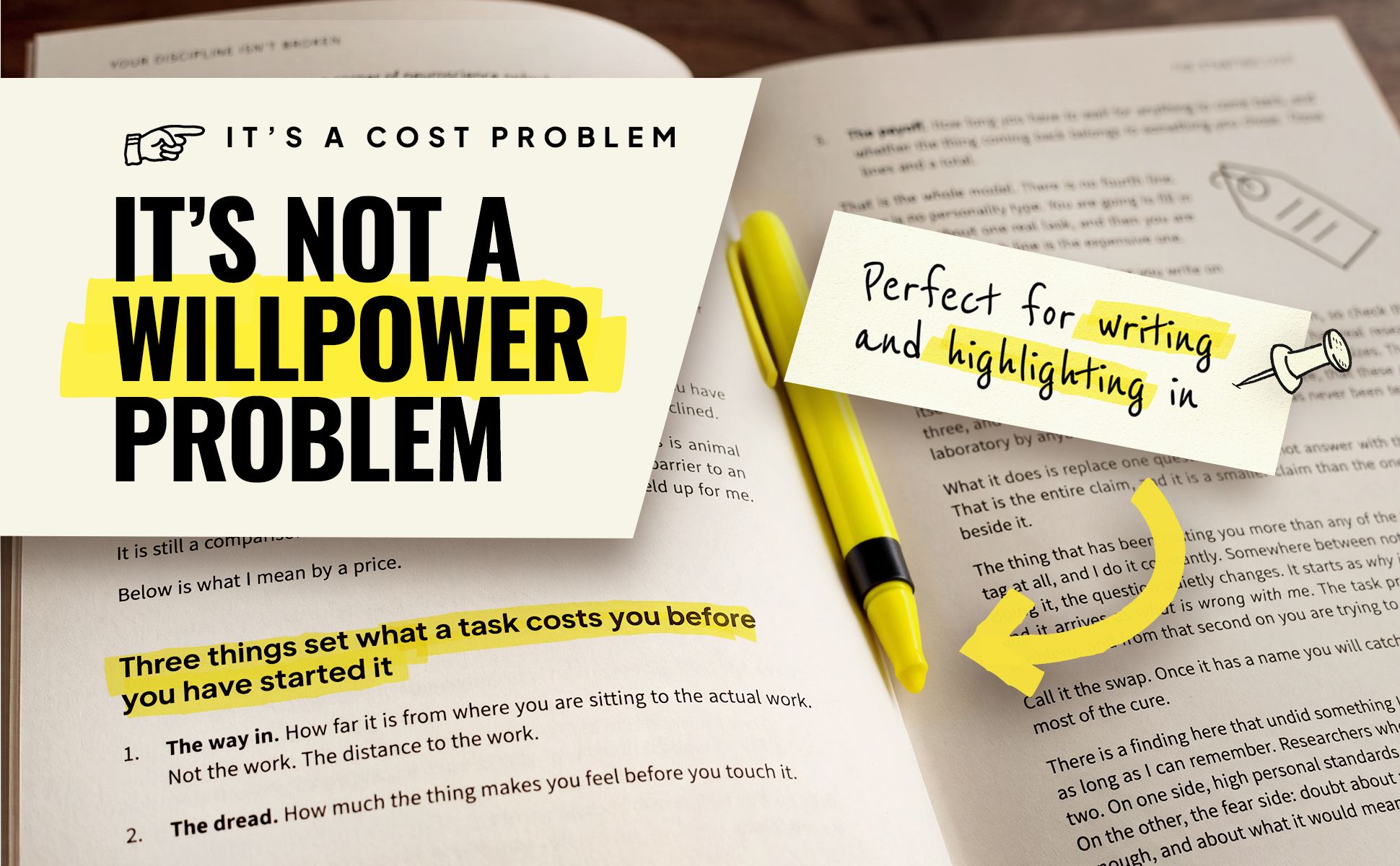
Perfect for writing and highlighting in
IS THIS YOU
The tax folder has dust on it. The invoice is unsent, for work you already finished, for money you actually need. And that same week you handled something genuinely difficult that nobody else wanted to touch. So it was never about capability.
You have quietly concluded it is about character. It is not. It is a price. Every task you avoid costs something before the work starts, and three things set that price: how far it is to the actual work, what it makes you feel on the way in, and how long you wait for anything to come back. You have been paying it without ever seeing the number.
This book makes you read the cost. Then it cuts it.
IT'S A COST PROBLEM
IT'S NOT A WILLPOWER PROBLEM
For years the story about dopamine was that it carries pleasure. That story is dead. One of the strongest strands of research points somewhere less romantic and far more useful: willingness to pay a cost. Give an animal two options. Ordinary food, no effort. Or better food, behind a small barrier. Healthy animals climb. Animals with their dopamine lowered do not climb. They still like the better food. The wanting was intact. The paying stopped.
You are not the problem. The task is charging you a price before you have even started it, and you have been paying that price without ever seeing the number. This book makes you read the number. Then it shows you how to cut it.

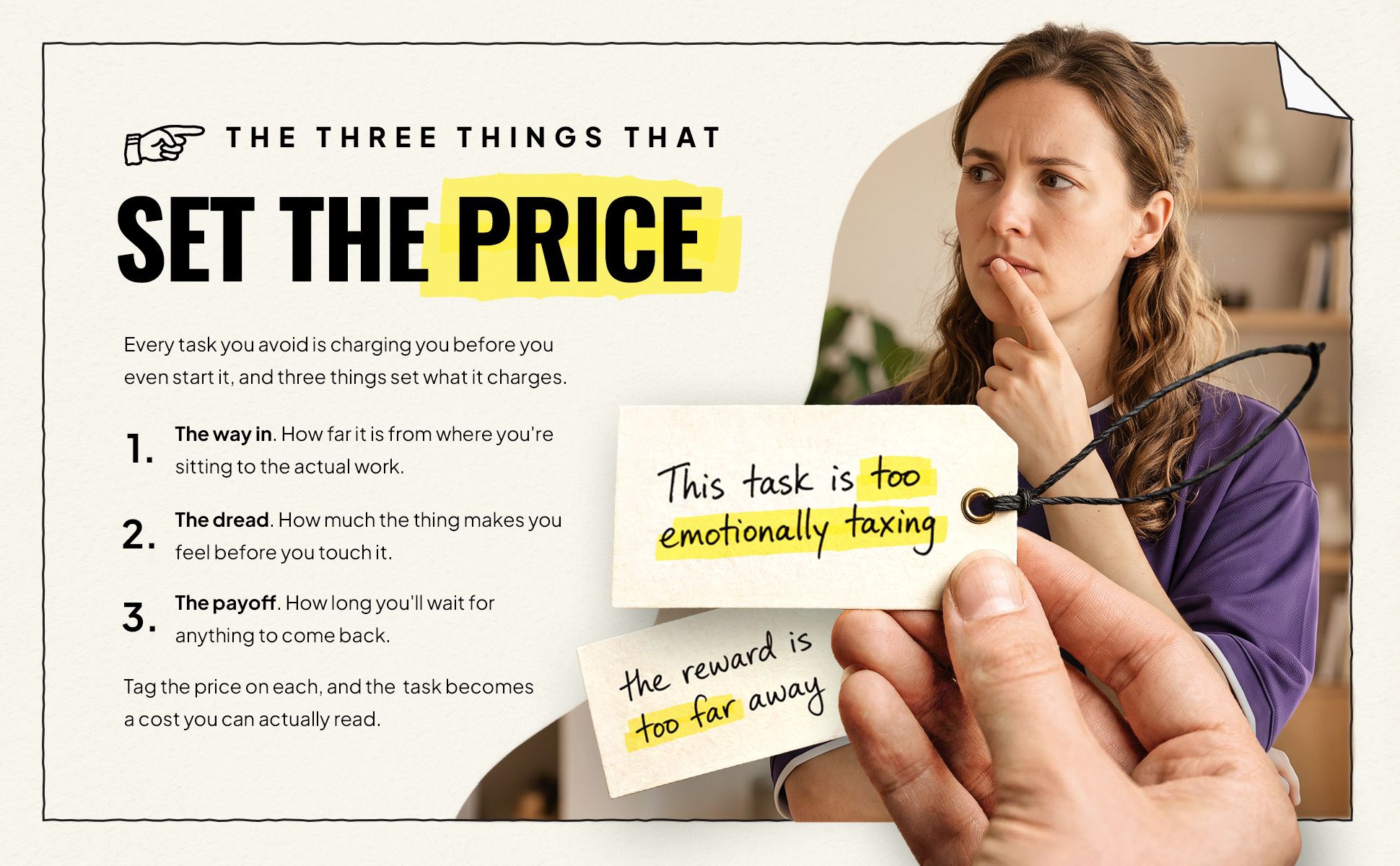
THE THREE THINGS THAT
SET THE PRICE
Every task you avoid is charging you before you even start it, and three things set what it charges.
-
The way in. How far it is from where you're sitting to the actual work.
-
The dread. How much the thing makes you feel before you touch it.
-
The payoff. How long you'll wait for anything to come back.
Tag the price on each, and the task becomes a cost you can actually read.
INSIDE
TWO SITTINGS. FIFTEEN SHORT CHAPTERS. FOURTEEN EXERCISES.
It opens by taking apart the self-help statistics nobody ever measured, including the ones you have organized your life around. It ends with a page for the day it does not happen, because that day is coming and every other book pretends it is not.
The chapters
- The Morning I Wrote This Instead
- Numbers That Were Never Measured
- The Starting Cost
- The Way In
- The Dread
- The Payoff
- The Dimension
- The Verdict
- Cut the Way In
- Cut the Dread
- Bring the Payoff Near
- Manufactured Deadlines
- Overdrawn
- The Lapse
- Before You Close It
The workbook
- The Dodge List
- Cross It Out
- Your First Price Tag
- Count the Moves
- The Dread Check
- The Payoff Check
- The Verdict
- The Short Way In
- The First Move, Unfelt
- Who It's Actually For
- One Real Consequence
- The Capacity Check
- The Lapse Plan
- The Restart Page
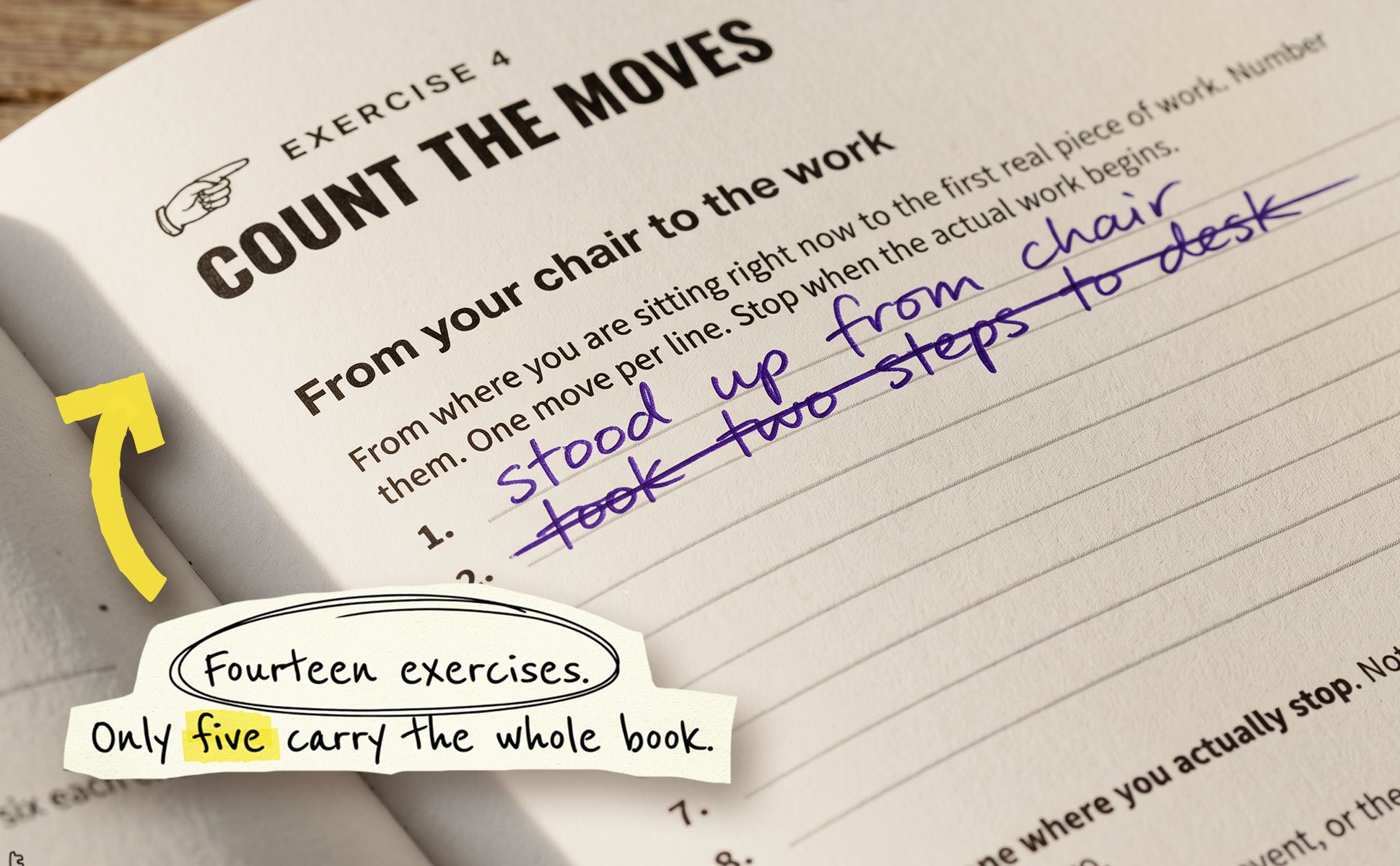
Fourteen exercises. Only five carry the whole book.
THE WORKBOOK
EVERY EXERCISE. FREE TO PRINT.
All fourteen exercises from the book, laid out to print at home. The ones in the book take ink once, and there are exercises here you will want again in a year. Print as many as you like.
No email needed. It is one PDF, all fourteen exercises, and there is nothing else in it.
IN FAIRNESS
WHAT THIS BOOK WILL NOT DO
It will not tell you that you need more discipline. It will not hand you a new personality. It will not promise that dull work becomes interesting. It does not, and you would catch me inside a week.

Great for that friend who keeps stalling
Short chapters easy enough to read anywhere.
Good to give to the friend who keeps stalling, not the one who's already fine.
THE AUTHOR
ABOUT ROZANNE DAY
Rozanne Day is a professional creative in South Africa, working across design, strategy and marketing. She built an agency that ran on the parts of that work which drained her most, and then spent years tired, flat, and putting off things she knew perfectly well how to do. She assumed it was a discipline problem. Everybody does.
It was not. Finding out what it actually was took a lot of research and several expensive mistakes. It changed the business, and then a good deal more than that. She wrote these books because keeping it to herself seemed unfair.
Your Discipline Isn't Broken is one of the It Was Never You books. Others include Your Spark Isn't Gone, for when the fire has gone out rather than gone expensive, and Your Genius Isn't Missing, for when you are brilliant in one room and flat in the next. Any of them can be read first. None of them needs the others.

QUESTIONS PEOPLE ASK
About the book
What is Your Discipline Isn't Broken about?
It is a short self-discipline book for capable people who stall on dull tasks. Its argument is that avoiding a task is not a character flaw but a price: three things set what a task costs you before you start, and none of them is who you are. The book shows you how to read that price on one real task and then how to cut it. Fifteen short chapters, fourteen exercises, meant to be read in two sittings.
Who is it for?
People who can do genuinely hard things and still cannot make themselves file the form, send the invoice, or open the folder. It is written for adults, in plain language, and it assumes you are competent. It is not for someone looking for a system to manage a whole life; it works on one task at a time.
Is this a book about ADHD?
No, and it does not diagnose anyone. The book treats starting difficulty as a dimension that runs through everybody, and every tool in it works wherever you sit on that dimension, with or without a name. It is honest about what is research and what is one clinician's hunch, every time.
Is it based on research?
Yes. The back of the book lists every source by name, with sample sizes, and the text says which findings are peer-reviewed science and which are extensions or comparisons. The book also spends a chapter taking apart several famous self-help statistics that were never measured.
Does it promise I will stop procrastinating?
No. It promises to make the cost of a task visible and then to cut it. It does not promise that dull work becomes interesting, and it says so on the cover.
Is it part of a series?
Yes. It is one of the It Was Never You books, a series of short books that can be read in any order. Each one takes something you have quietly decided is wrong with you and finds what was actually happening instead.
Buying, reading, printing
Where can I buy it?
On Amazon, as a paperback and as a Kindle ebook. The Kindle edition is in Kindle Unlimited. The button at the top of this page goes straight to the listing.
How long does it take to read?
Two sittings, with a natural break after chapter eight. The paperback is 124 pages. If your week has one long evening in it instead, use that.
Is the workbook really free?
Yes. All fourteen exercises from the book are one PDF, free to download from this page, with no email address asked for. Print as many copies as you like.
Do I have to do all fourteen exercises?
No. Five of them carry the book: 1, 3, 7, 13 and 14. The rest are optional, and none of them is a debt.
I found an error. What do I do?
Use the form at the bottom of this page and choose "an error I found." The book argues that being handed an unchecked number is a kind of harm, so a correction is welcome, and it will be fixed in the next printing.
THE SERIES
WHEN THE NEXT ONE IS OUT.
WRITE TO ME
FOUND AN ERROR? HAVE A QUESTION?
Every message comes to me and I read them. If you found a mistake in the book, tell me the page and what it should say. If you have a question about the book, ask it. If you just want to say something, that is welcome too.